
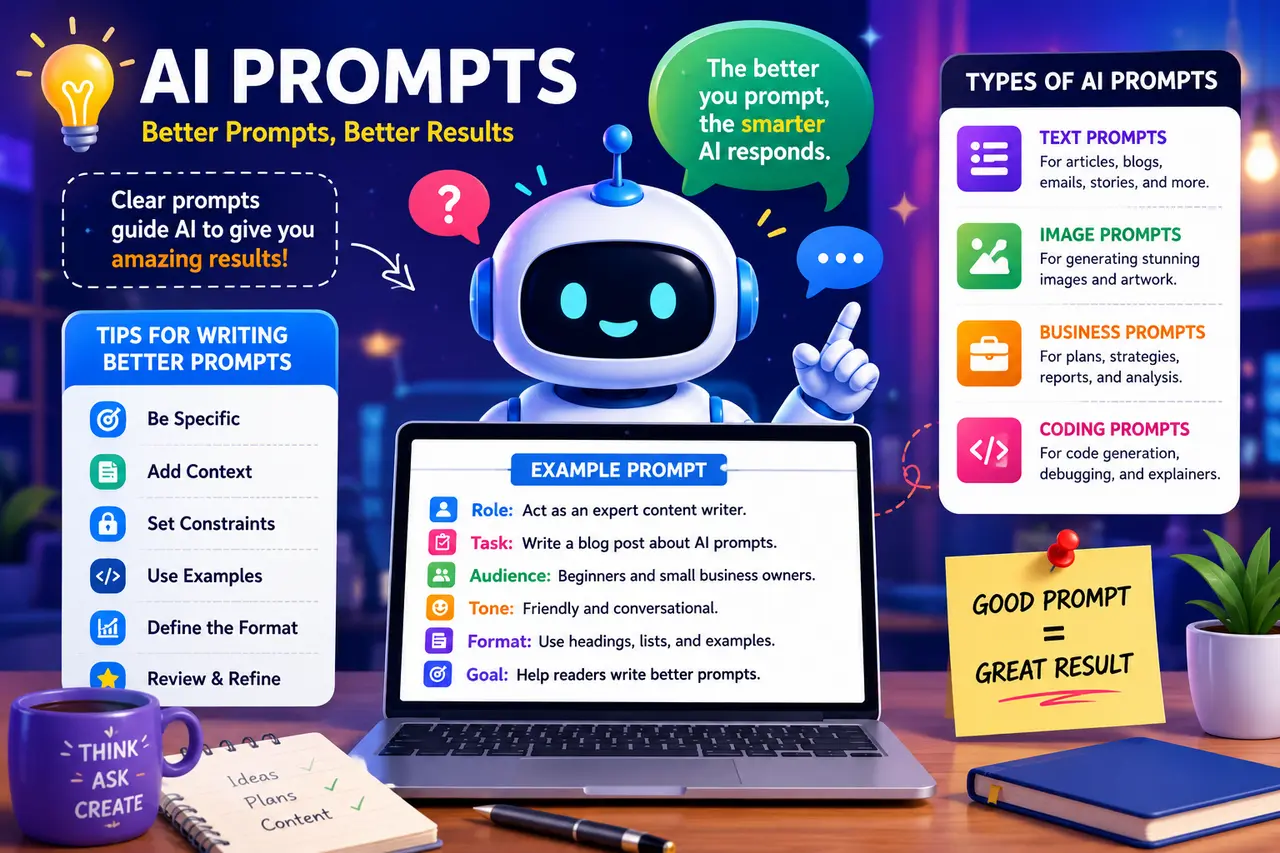
AI prompts are the instructions you give to an artificial intelligence tool so it can produce a useful result. Think of a prompt like giving directions to a very smart assistant who can write, design, research, summarize, brainstorm, analyze, code, plan, and create—but only if you explain what you want clearly. A weak prompt is like saying, “Make me something good,” and hoping for magic. A strong prompt is like handing over a map, a destination, a deadline, a style guide, and a clear reason for the task. That difference is why two people can use the same AI tool and get completely different results.
At its core, an AI prompt tells the model what role to take, what task to complete, what information to use, what format to follow, and what quality standard to aim for. For example, “Write a blog post about healthy meal prep” is usable, but it is not very powerful. A better version would say, “Act as a nutrition-focused blog writer. Write a beginner-friendly article about healthy meal prep for busy parents, using a warm conversational tone, practical examples, and a simple weekly plan.” See the difference? The second prompt gives the AI a clear lane to drive in, instead of throwing it onto the highway blindfolded.
Why AI Prompts Matter More Than Ever
AI prompts matter because generative AI has moved from being a novelty to becoming a real productivity tool for businesses, creators, teachers, marketers, developers, authors, and everyday users. The better your prompt, the better your output. That does not mean AI will always be perfect, because it still needs review, editing, and human judgment. But strong prompting reduces confusion, saves time, improves accuracy, and helps you get closer to a publishable or usable result on the first few tries. In a world where everyone has access to similar AI tools, the person who gives better instructions often gets better work.
This is why prompt engineering has become such a valuable skill. You do not need to be a programmer to benefit from it. You simply need to understand how to communicate with AI in a structured way. A good prompt can help you write a sales page, create a lesson plan, generate a book outline, design a social media campaign, explain a complex topic, or turn rough ideas into polished content. Bad prompts create generic answers. Great prompts create focused, useful, and surprisingly creative results.
How AI Prompts Work
AI prompts work by giving a language model a pattern to follow. The model reads your words, predicts what kind of answer would best match your request, and then generates a response based on its training, context, and instructions. That sounds technical, but the simple version is this: AI responds to the quality of your direction. If your request is broad, the answer will usually be broad. If your request is detailed, the answer has a much better chance of being detailed, relevant, and useful. It is a little like ordering food. If you just say “bring me dinner,” you may get anything. If you say “bring me grilled chicken, rice, vegetables, no sauce, and keep it under 600 calories,” the result becomes much easier to control.
The best prompts usually include several ingredients: a role, a task, context, constraints, examples, and output format. You do not need every ingredient every time, but the more important the task is, the more helpful those pieces become. For quick tasks, a short prompt may be enough. For high-value work like an SEO article, business plan, product description, book chapter, or customer email, you want to be more intentional. AI does not read your mind. It responds to what you provide, so the goal is to remove guesswork.
The Simple Prompt Formula
A reliable AI prompt formula is: Role + Task + Context + Constraints + Format + Quality Standard. For example: “Act as an experienced SEO writer. Create a blog outline for an article about AI prompts. The audience is beginners and small business owners. Use a conversational tone, include H2 and H3 headings, avoid jargon, and make the structure easy to follow.” That prompt works because it gives the AI a job, a subject, an audience, a tone, and a format. It does not just ask for “an outline.” It explains what kind of outline is needed.
You can use this formula for almost anything. Need an email? Give the AI the sender, recipient, goal, tone, and key points. Need a book idea? Give it the genre, audience, length, theme, and emotional promise. Need an image prompt? Give it the subject, style, composition, lighting, colors, and aspect ratio. Prompting is not about writing long instructions for the sake of it. It is about giving enough useful information so the AI does not have to guess.
Types of AI Prompts
There are many types of AI prompts, and each one serves a different purpose. Some prompts are simple commands, while others are detailed creative briefs. Some are designed for text generation, while others guide image tools, coding assistants, research tools, customer service bots, or business automation systems. The type of prompt you use depends on the output you want. Asking AI to write a poem is very different from asking it to create a legal-style contract summary or a product launch plan. The clearer you are about the type of output, the better the tool can respond.
A helpful way to think about prompts is to group them by outcome. Are you trying to create something, improve something, analyze something, compare options, summarize information, or make a decision? Once you know the outcome, you can shape the prompt around that goal. For example, a creation prompt might ask AI to generate a blog post. An improvement prompt might ask it to rewrite that blog post in a warmer tone. An analysis prompt might ask it to evaluate the article’s SEO strength. Each prompt has a different job, so each one needs different instructions.
Text Prompts
Text prompts are the most common type of AI prompt. These are used to generate articles, emails, captions, scripts, outlines, summaries, product descriptions, ad copy, lesson plans, stories, reports, and more. A strong text prompt should usually include the topic, audience, tone, length, structure, and purpose. For example, “Write a 500-word email newsletter for small business owners about saving time with AI tools” is much stronger than “Write about AI.” The first prompt points the AI toward a specific reader and a specific result.
Text prompts work best when you tell the AI what to avoid as well as what to include. You might say, “Avoid hype, keep the tone practical, and do not use technical jargon.” That kind of instruction prevents the output from becoming fluffy or robotic. You can also ask for a specific style, such as friendly, professional, persuasive, educational, witty, warm, bold, or beginner-friendly. Tone matters because the same information can feel completely different depending on how it is written.
Image Prompts
Image prompts are used to guide AI image generators. These prompts usually describe the subject, background, artistic style, camera angle, lighting, mood, color palette, and composition. For example, “A cheerful robot teacher helping children learn letters in a bright classroom, colorful educational poster style, clean layout, soft lighting, kid-friendly illustration” gives the image model much more to work with than “robot teacher.” A good image prompt paints a picture with words before the AI paints the picture visually.
The secret to better image prompts is specificity without clutter. You want enough detail to guide the image, but not so many competing ideas that the final result becomes messy. For commercial or educational images, you should also include layout needs, such as space for a title, readable labels, clean margins, or a poster-style composition. Image prompting is especially useful for book covers, classroom posters, worksheets, social media banners, thumbnails, logos, and product mockups.
Business Prompts
Business prompts help users save time and make better decisions. These prompts can generate marketing plans, customer personas, email sequences, SWOT analyses, sales scripts, onboarding documents, standard operating procedures, meeting agendas, and content calendars. A business prompt should always include the business type, target audience, goal, offer, constraints, and desired output. For example, “Create a 30-day content plan for a local dog grooming salon targeting busy pet owners in Seattle” is far more useful than “Make a content plan.”
Business prompts become even stronger when you include real details. If you give AI your price point, customer pain points, brand tone, location, offer, and competitors, the answer becomes more practical. Without those details, the model may produce advice that sounds polished but feels generic. The goal is not just to get words on a page. The goal is to get strategy, structure, and execution support that fits the real business.
Prompt Engineering Explained
Prompt engineering is the process of designing prompts in a way that improves the quality, accuracy, and usefulness of AI outputs. It sounds fancy, but the basic idea is simple: better instructions produce better responses. Prompt engineering can include writing clearer commands, adding context, using examples, setting constraints, asking the model to reason step by step, or requesting a specific format. It is both a creative skill and a practical communication skill.
You can think of prompt engineering like directing a talented actor. If you simply say, “Act sad,” the performance may be vague. If you say, “You are a father reading an old letter from your child after years of silence; keep the emotion quiet, restrained, and heavy,” the performance becomes richer. AI works in a similar way. It needs direction, motivation, boundaries, and context to produce something that feels intentional.
Prompt Engineering vs Regular Prompting
Regular prompting is asking AI for something. Prompt engineering is designing the request so the answer is more reliable. A regular prompt might say, “Write a product description.” A prompt-engineered version would say, “Act as an ecommerce copywriter. Write a persuasive product description for a reusable stainless steel water bottle. Target busy professionals who want a stylish, eco-friendly option. Use a confident tone, focus on benefits, include sensory details, and end with a soft call to action.” Both prompts ask for the same general thing, but the second one gives the AI a much better target.
The difference matters because AI tools are flexible. That flexibility is powerful, but it also means vague prompts can lead to vague answers. Prompt engineering narrows the possibilities. It tells the model what matters, what does not matter, and how success should look. That is why prompt engineering is useful for SEO, copywriting, education, coding, design, research, customer support, productivity, and almost every other field using generative AI.
Best Practices for Writing AI Prompts
The best AI prompts are clear, specific, and purposeful. You do not need to sound technical. You just need to be precise. Start by deciding what you want the AI to produce. Then explain who the output is for, what tone it should use, what format it should follow, and what information must be included. This simple habit instantly improves your results. Most poor AI outputs happen because the prompt leaves too much open to interpretation.
Another best practice is to treat prompting as a conversation instead of a one-shot command. Your first result does not have to be the final result. You can ask the AI to revise, expand, simplify, make it more persuasive, add examples, remove fluff, improve structure, or change the tone. This back-and-forth process is where AI becomes truly useful. The first prompt gets you started. The follow-up prompts help you shape the result into something better.
Be Specific With Your Goal
Specificity is the backbone of good prompting. Instead of saying, “Write about AI prompts,” say, “Write a beginner-friendly guide explaining what AI prompts are, why they matter, how to write better ones, and include examples for bloggers, business owners, and teachers.” That version gives the AI a clear goal and a clear audience. It also tells the model what content to include, which reduces the chance of a thin or scattered response.
A specific goal also helps you measure whether the output is successful. If you ask for “good content,” what does good mean? Does it mean funny, detailed, short, persuasive, technical, emotional, or SEO-friendly? The AI cannot know unless you say so. Specific prompts create specific results, and specific results are easier to edit, publish, or use.
Add Context and Constraints
Context tells AI what situation it is working inside. Constraints tell it where the boundaries are. Both are important. For example, if you ask AI to create a social media strategy, it needs to know the platform, audience, niche, posting frequency, brand personality, and goal. If you do not provide that context, it may give you a generic strategy that could apply to anyone. Useful content usually comes from details.
Constraints are equally powerful. You can tell the AI to keep the answer under 300 words, avoid technical language, write for beginners, use a warm tone, include three examples, or format the output as a table. Constraints do not limit creativity in a bad way. They focus it. Like a picture frame, they help the final result feel complete instead of scattered.
Use Examples When Needed
Examples are one of the fastest ways to improve AI output. If you want a certain style, show the AI a sample. If you want a specific format, provide a template. If you want a particular type of answer, include one example of what “good” looks like. This is especially helpful for brand voice, product descriptions, lesson plans, email sequences, social media captions, and structured reports.
Examples work because they reduce ambiguity. Instead of explaining everything from scratch, you can say, “Use this style,” “Follow this structure,” or “Make it similar in tone but not copied.” That gives the AI a pattern to follow. Just make sure your examples are yours to use or are short enough to serve as guidance rather than copied material. AI should help you create original work, not recycle someone else’s.
Common AI Prompt Mistakes
The most common AI prompt mistake is being too vague. Many users type one short sentence, get a bland answer, and then assume the AI is not useful. But the real problem is often the instruction. If you give a vague prompt, you invite a vague response. AI is not a mind reader. It needs direction. The more important the output is, the more care you should put into the prompt.
Another mistake is expecting the first answer to be perfect. AI is powerful, but it still benefits from editing and refinement. A strong workflow often looks like this: ask for a draft, review it, request improvements, add missing details, fact-check important claims, and polish the final version. This process turns AI from a random content machine into a useful creative partner.
Vague Instructions
Vague instructions create generic content. Prompts like “Write a blog post,” “Make this better,” or “Give me ideas” can work for quick brainstorming, but they usually do not produce high-quality results. The AI does not know your audience, your goal, your tone, your brand, your preferred length, or what kind of examples you want. It fills in the blanks, and those guesses may not match your needs.
A better approach is to include the missing details upfront. Instead of “Make this better,” say, “Rewrite this paragraph to sound more professional, clearer, and more persuasive for small business owners. Keep the meaning the same, but remove repetition and make the final sentence stronger.” That prompt gives the AI a job description. It tells the model what “better” means.
Asking Too Much at Once
Another common mistake is asking AI to do too many unrelated things in one prompt. For example, asking it to research, write, edit, format, create images, build a strategy, and generate social posts all in one instruction can lead to messy results. AI can handle complex tasks, but complex tasks work better when broken into steps. First ask for research. Then ask for an outline. Then ask for the draft. Then ask for optimization.
Step-by-step prompting gives you more control. It also lets you catch problems early. If the outline is weak, you can fix it before writing the full article. If the strategy is off, you can adjust before creating the content calendar. Think of it like building a house. You do not start with curtains. You start with the foundation.
AI Prompt Examples You Can Use
Good examples make prompt writing easier, especially when you are just starting. You do not need to memorize complicated formulas. You can begin with a reusable structure and adapt it for your task. The best prompt examples usually include a role, task, audience, tone, format, and goal. Once you get comfortable, you can customize them for writing, business, education, design, coding, research, and productivity.
Here is a simple comparison showing how weak prompts can become stronger:
| Weak Prompt | Strong Prompt |
|---|---|
| Write about AI prompts. | Write a beginner-friendly blog post explaining AI prompts, how they work, and how small business owners can use them. |
| Make this better. | Rewrite this paragraph to sound clearer, warmer, and more persuasive while keeping the meaning the same. |
| Give me ideas. | Give me 20 content ideas for a parenting blog focused on toddler sleep, using SEO-friendly titles. |
| Create an image prompt. | Create a detailed image prompt for a premium children’s educational poster about ocean animals, ages 6–8. |
Content Creation Prompt Example
A strong content creation prompt might look like this: “Act as an experienced SEO content writer. Create a 1,500-word blog post about AI prompts for beginners. Use a conversational tone, include practical examples, explain common mistakes, and structure the article with H2 and H3 headings. Add a short introduction, a helpful conclusion, and five FAQs.” This prompt is effective because it explains the role, topic, audience, tone, structure, and deliverables.
You can adjust this prompt for almost any niche. If you write about fitness, parenting, education, finance, recipes, faith-based topics, or business, simply change the topic and audience. The structure still works. That is the beauty of reusable prompts. Once you understand the framework, you can create better content faster without starting from zero every time.
Business Strategy Prompt Example
A business strategy prompt might say: “Act as a small business consultant. Create a 30-day marketing plan for a local bakery that wants to increase weekend orders. The target audience is families, office workers, and event planners. Include weekly themes, social media post ideas, email ideas, promotional offers, and simple success metrics.” This prompt gives the AI enough detail to create something practical instead of generic.
For even better results, add your real business details. Include your location, prices, best-selling products, brand style, customer objections, and current marketing channels. AI becomes more useful when it has real information to work with. The more grounded your prompt is, the more grounded the answer becomes.
The Future of AI Prompts
The future of AI prompts is moving toward more structured, personalized, and automated workflows. Basic prompting will still matter, but users are increasingly building prompt chains, custom GPTs, AI agents, templates, and reusable systems. Instead of asking one question at a time, people are creating workflows where AI researches, outlines, drafts, edits, formats, and repurposes content in stages. This is where prompting becomes less like typing commands and more like designing a process.
At the same time, prompts are becoming more natural. AI tools are getting better at understanding messy human requests, but that does not mean prompting skill is becoming useless. It means the skill is evolving. The best users will know how to combine clear instructions, strong judgment, good examples, and smart follow-up questions. In other words, the future belongs to people who can direct AI well, not just people who can access AI.
Conclusion
AI prompts are the bridge between your idea and the AI’s output. If the bridge is weak, the result may collapse into generic content, confusing answers, or wasted time. If the bridge is strong, AI can become a powerful assistant for writing, planning, designing, researching, teaching, marketing, and problem-solving. The good news is that writing better prompts is not complicated. You just need to be clear about your goal, audience, context, constraints, and desired format.
The biggest shift is mental. Stop treating AI like a magic button and start treating it like a creative partner that needs direction. Give it a role. Tell it the task. Share the context. Set the boundaries. Ask for the format you want. Then revise through follow-up prompts until the result is strong enough to use. That is how you move from average AI output to content and ideas that actually feel useful.
FAQs
1. What is an AI prompt?
An AI prompt is an instruction or request you give to an AI tool to generate a response. It can be a question, command, creative brief, template, or detailed set of directions.
2. What makes a good AI prompt?
A good AI prompt is clear, specific, and contextual. It usually includes the task, audience, tone, format, constraints, and desired outcome.
3. Is prompt engineering hard to learn?
No, prompt engineering is not hard to learn. The basics are simple, and most users can improve quickly by adding more context, examples, and clear instructions.
4. Can AI prompts help with SEO content?
Yes, AI prompts can help with SEO research, outlines, meta descriptions, article drafts, FAQs, keyword clustering, and content improvement. Human review is still important for quality and accuracy.
5. What is the biggest mistake beginners make with AI prompts?
The biggest mistake is being too vague. Short prompts can work, but detailed prompts usually produce better, more useful results.






0 Comments