
Understanding AI Automation
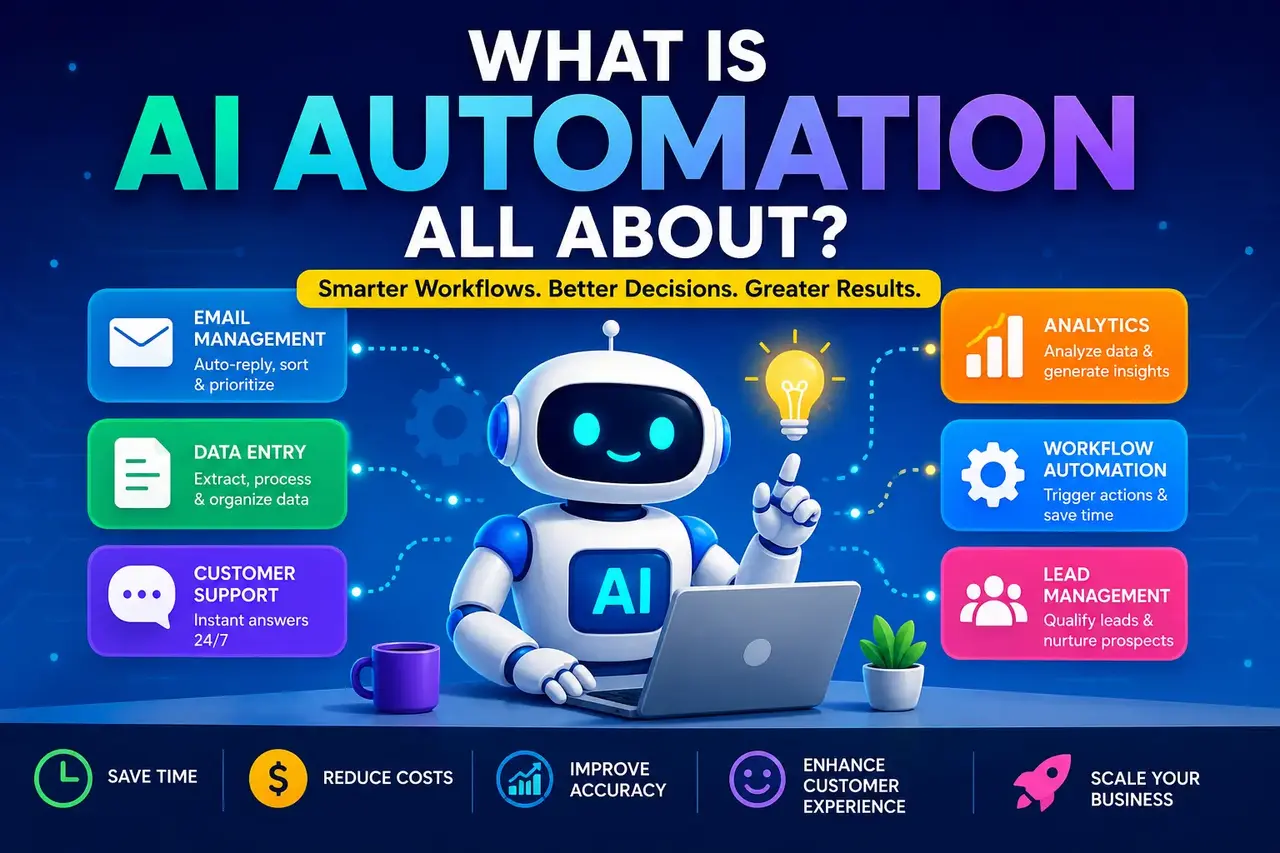
AI automation is the use of artificial intelligence to complete tasks, improve workflows, make decisions, and reduce manual effort across business operations. Instead of relying only on people to repeat the same steps every day, we use intelligent systems that can analyze information, recognize patterns, generate content, respond to customers, update records, trigger workflows, and support decision-making.
Traditional automation follows fixed rules. AI automation goes further because it can work with language, data, images, documents, customer behavior, and changing business conditions. This makes it especially useful for companies that want to move faster, reduce errors, and improve productivity without adding unnecessary complexity.
At its core, AI automation is about helping us turn slow, repetitive, and time-consuming work into smarter systems that operate with speed, consistency, and accuracy.
How AI Automation Works
AI automation works by combining artificial intelligence, machine learning, workflow automation, and sometimes robotic process automation. These technologies allow software to understand inputs, process information, and perform actions.
For example, an AI automation system can read an email, identify the customer’s request, classify the issue, create a support ticket, suggest a response, and notify the correct team. In a sales department, it can score leads, personalize follow-up messages, update a CRM, and remind the sales team when a prospect is ready for contact.
The process usually includes three major steps: input, intelligence, and action. The system receives information, uses AI to understand or evaluate it, and then performs the next step automatically.
Why AI Automation Matters
AI automation matters because businesses are under pressure to do more with less. Teams need to respond faster, serve customers better, reduce costs, and stay competitive. Manual work slows this down.
With AI automation, we can remove bottlenecks from daily operations. Instead of spending hours copying data, writing repetitive emails, sorting documents, or checking reports, teams can focus on higher-value work such as strategy, creativity, relationship-building, and problem-solving.
The value of AI automation is not only speed. It also creates consistency, scalability, and better decision support. A well-built AI automation system can perform the same process hundreds or thousands of times without fatigue, while also learning from patterns and improving outputs over time.
Examples of AI Automation in Business
AI automation can be used in nearly every department.
In customer service, AI chatbots can answer common questions, route complex issues, summarize conversations, and help agents respond faster.
In marketing, AI automation can create content drafts, segment audiences, personalize campaigns, analyze performance, and schedule posts.
In sales, it can qualify leads, write outreach emails, update customer records, and identify buying signals.
In finance, AI automation can process invoices, detect unusual transactions, reconcile data, and generate reports.
In human resources, it can screen applications, schedule interviews, answer employee questions, and support onboarding.
In operations, AI automation can monitor workflows, flag delays, assign tasks, and improve resource planning.
The common theme is simple: AI automation helps us handle repetitive, data-heavy, or communication-based work more efficiently.
AI Automation vs. Traditional Automation
Traditional automation is rule-based. It works well when every step is predictable. For example, “when a form is submitted, send a confirmation email” is traditional automation.
AI automation is more flexible. It can understand natural language, summarize information, classify messages, extract meaning from documents, and adapt to different situations.
Traditional automation follows instructions. AI automation interprets, decides, and assists.
This difference is important because many business tasks are not perfectly structured. Emails are written differently. Customers ask questions in different ways. Documents contain different formats. AI automation helps manage this complexity.
The Role of Generative AI in Automation
Generative AI has made automation more powerful because it can create text, ideas, summaries, scripts, images, code, and structured outputs. This means automation is no longer limited to moving data from one place to another.
We can now automate parts of creative and knowledge work. For example, AI can draft blog posts, summarize meetings, create product descriptions, prepare proposals, generate training materials, and rewrite messages for different audiences.
However, the best use of generative AI is not replacing human judgment. It is helping us produce first drafts, speed up research, organize information, and complete routine communication faster.
What Are AI Agents?
AI agents are a more advanced form of AI automation. An AI agent can be given a goal and then complete multiple steps to reach that goal. Instead of responding to one instruction at a time, an agent can plan, use tools, check information, make decisions, and continue working through a process.
For example, an AI agent could research potential customers, build a lead list, draft outreach messages, update a spreadsheet, and prepare a summary report.
This is why agentic AI automation is becoming a major topic in business. It moves automation from simple tasks toward more complete workflows.
Benefits of AI Automation
The biggest benefit of AI automation is productivity. Teams can complete more work in less time because routine tasks are handled automatically.
Another major benefit is cost efficiency. When repetitive work is automated, businesses can reduce wasted time and improve output without constantly expanding headcount.
AI automation also improves accuracy. Manual data entry, missed follow-ups, and inconsistent processes can create costly errors. Automation reduces these risks when systems are properly designed.
It also supports better customer experience. Customers receive faster responses, more personalized communication, and smoother service.
Finally, AI automation gives businesses scalability. A process that works for 100 customers can often be expanded to 10,000 customers with the right systems in place.
Challenges of AI Automation
AI automation is powerful, but it must be implemented carefully. Poorly designed automation can create confusion, errors, or low-quality outputs.
One challenge is data quality. AI systems depend on accurate and organized information. If the data is messy, incomplete, or outdated, the automation may produce weak results.
Another challenge is over-automation. Not every task should be automated. Some decisions require human empathy, experience, or strategic judgment.
Security is also important. AI automation may connect to sensitive systems, customer records, financial data, or private documents. Businesses need clear permissions, monitoring, and governance.
The goal is not to automate everything. The goal is to automate the right things.
Where AI Automation Works Best
AI automation works best in tasks that are repetitive, time-consuming, rule-guided, and information-heavy.
Good examples include email sorting, report generation, customer support triage, appointment scheduling, invoice processing, lead scoring, content repurposing, document summarization, and internal knowledge search.
It also works well when a process has clear inputs and outputs. The clearer the workflow, the easier it is to automate successfully.
AI automation is less suitable for tasks that require deep emotional judgment, high-risk legal decisions, sensitive medical conclusions, or complex ethical reasoning without human oversight.
How We Should Start With AI Automation
The best way to start is by identifying repetitive tasks that consume time every week. We should look for work that is necessary but not the best use of human talent.
A strong starting point is to ask: What do we repeat often? What slows us down? What causes errors? What takes time but does not require deep judgment?
Once those tasks are identified, we can map the workflow step by step. Then we decide where AI should help and where a human should stay involved.
Successful AI automation usually starts small. We build one useful workflow, test it, improve it, and then expand.
The Future of AI Automation
The future of AI automation will be more connected, more personalized, and more agent-driven. Businesses will increasingly use AI systems that do not only respond to commands but help manage entire workflows.
We will see more AI automation in customer service, education, healthcare administration, finance, marketing, logistics, and small business operations.
The companies that benefit most will be those that combine automation with clear strategy. They will not use AI simply because it is trendy. They will use it to solve real problems, improve real processes, and create better results.
Final Thoughts on AI Automation
AI automation is all about using intelligent technology to make work faster, smarter, and more efficient. It helps us reduce repetitive tasks, improve decision-making, serve customers better, and scale business operations.
The real power of AI automation is not just replacing manual work. It is giving people more time to focus on the work that actually requires human creativity, leadership, trust, and judgment.
When used correctly, AI automation becomes a practical business advantage. It helps us build stronger systems, smoother workflows, and more productive teams in a world where speed and intelligence matter more than ever.





0 Comments